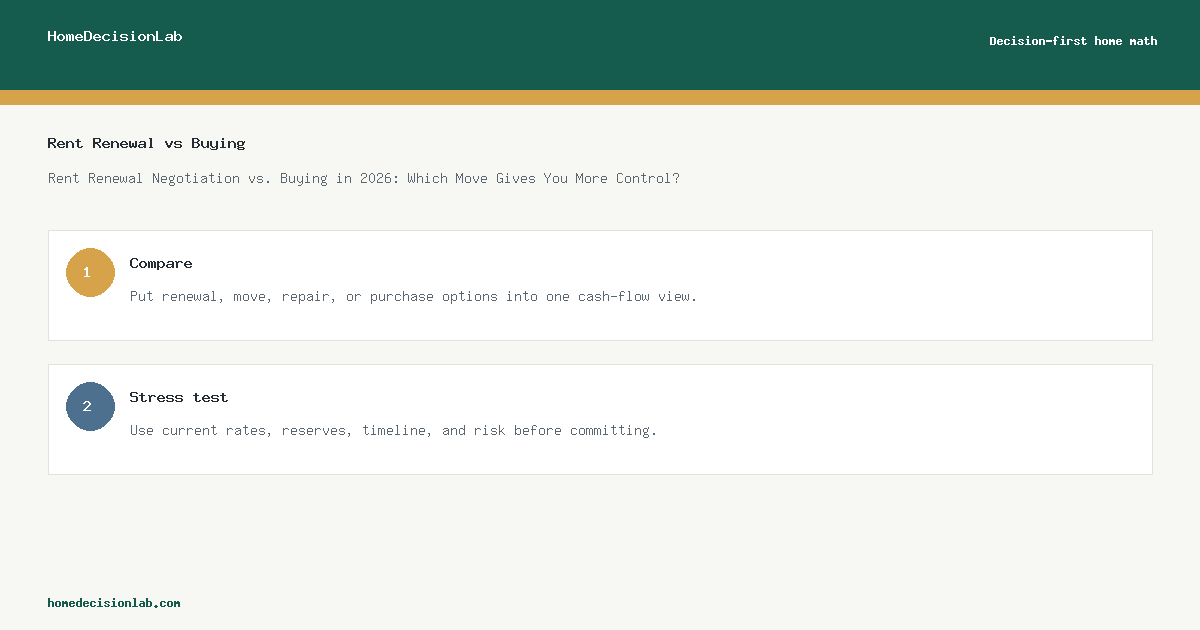
Rent Renewal Negotiation vs. Buying in 2026: Which Move Gives You More Control?
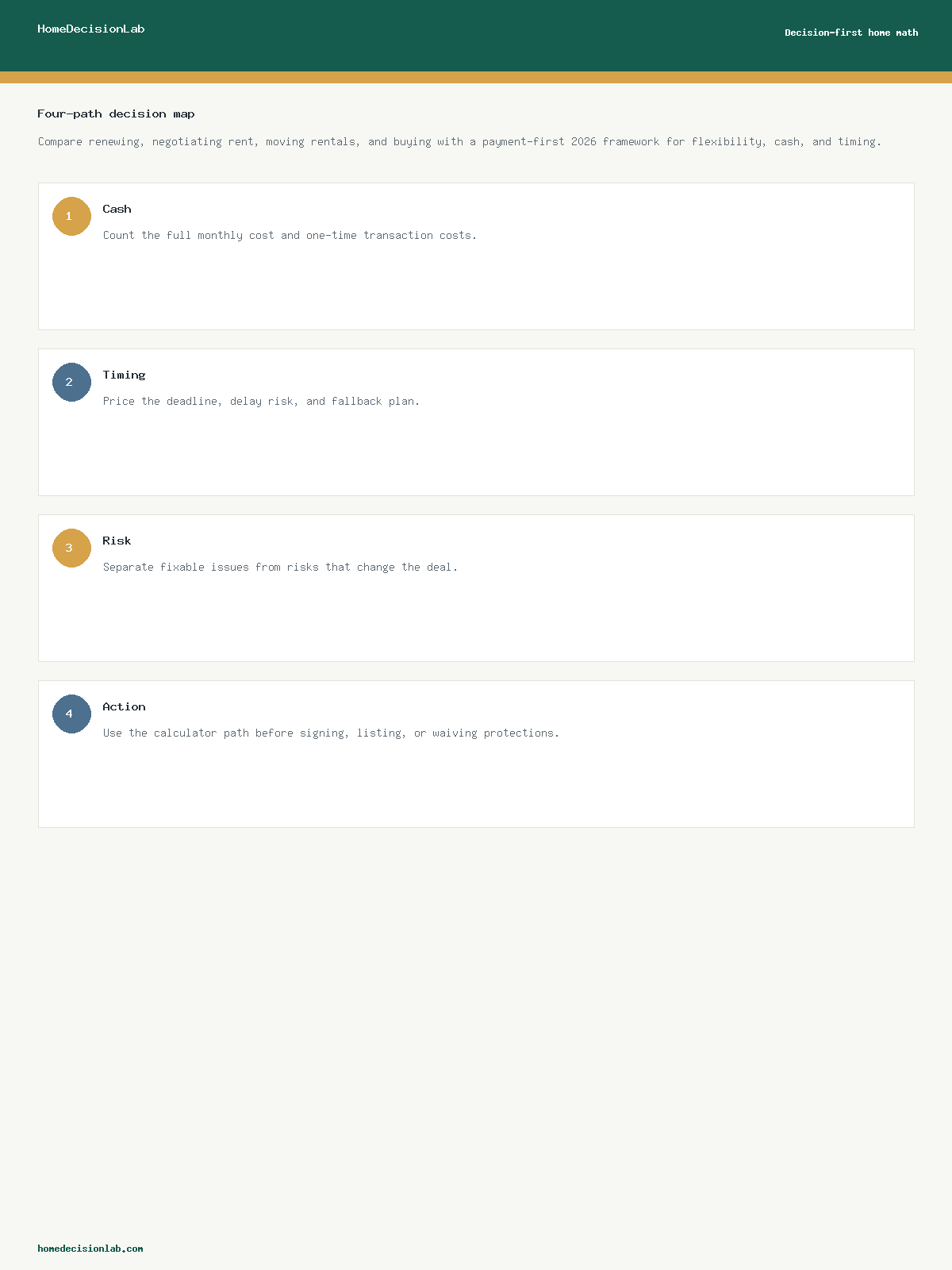
Compare renewing, negotiating rent, moving rentals, and buying with a payment-first 2026 framework for flexibility, cash, and timing.
Compare renewing, negotiating rent, moving rentals, and buying with a payment-first 2026 framework for flexibility, cash, and timing. This guide is designed to make the decision slower, clearer, and more useful than a rule of thumb.
Quick answer
A lease renewal is not just a housing chore. It is a decision point where you can buy time, negotiate a better monthly cost, move to a different rental, or start a purchase search. The right answer in 2026 depends less on whether buying sounds attractive and more on whether ownership would improve your cash flow, stability, and five-year flexibility after closing costs and maintenance are included. Use current market context as a guardrail, not as the decision itself. Freddie Mac reported the average 30-year fixed mortgage rate at 6.43% on July 2, 2026, with the 15-year fixed rate at 5.79%. Redfin's May 2026 U.S. housing overview showed a median sale price of $398,771, up 2.0% year over year, while the National Association of REALTORS reported a May existing-home median price of $429,300, 4.17 million seasonally adjusted annual existing-home sales, and 4.5 months of inventory. Those national figures do not decide your local move, but they explain why payment discipline, negotiation leverage, and cash reserves matter in the second half of 2026.
If your renewal offer is modest, your neighborhood still works, and buying would stretch reserves, renewing can be the financially stronger move. If rent is rising sharply, your household is stable, and you have enough cash after down payment and closing costs, buying may deserve a serious comparison. The mistake is treating the renewal deadline as a yes-or-no panic. Turn it into a 60-day decision window with numbers.
Start with the renewal math
Ask for the renewal offer in writing and separate base rent from fees, parking, pet rent, utilities, storage, and required services. A $150 rent increase may really be a $240 monthly increase if bundled fees changed at the same time. Annualize the full increase, then compare it with the cash cost of moving and the monthly cost of buying.
Use this formula: renewal cost for the next year equals new monthly housing cost minus current monthly housing cost, multiplied by twelve, plus any one-time renewal fees. If the increase is $220 per month and fees add $300, the one-year renewal cost is $2,940. That number is your negotiation target and your benchmark for whether moving or buying is worth the disruption.
Negotiate before you shop
Many renters skip negotiation because they assume the renewal letter is final. It often is not. Ask for a smaller increase, a longer lease with a capped increase, one free month, included parking, waived amenity fees, or permission to go month-to-month while you evaluate buying. The landlord may prefer a reliable tenant over vacancy and turnover cost.
Frame the ask around certainty. You can say that you are ready to renew quickly at a lower number, that comparable listings are lower, or that you need flexibility because you are evaluating a home purchase. Do not bluff about buying if you are not ready. The strongest position is a specific, calm alternative: renew at this price, move to this rental, or begin a purchase search with this budget.
Build a buy-versus-renew payment
A purchase comparison should use the full monthly owner cost: principal and interest, property tax, homeowners insurance, mortgage insurance if any, HOA dues, maintenance reserve, utilities that shift from landlord to owner, and a repair buffer. The mortgage payment alone is not enough.
At a 6.43% mortgage rate, every extra $10,000 of loan amount adds roughly $63 per month in principal and interest on a 30-year fixed loan before taxes and insurance. That means a $40,000 price difference can move the payment by about $250 per month. In tight affordability situations, price discipline matters more than winning the first house you like.
Compare four paths
Use a four-path table instead of a binary rent-versus-buy debate. Renewal keeps friction low. Negotiation improves the same home. Moving rentals resets cost and location. Buying trades flexibility for control and possible long-term equity. Each path has a different cash requirement and failure mode.
| Path | Best when | Watch-out |
|---|---|---|
| Renew | Increase is small and location still works | May postpone a needed move |
| Negotiate | You are a strong tenant with alternatives | Requires a clear ask and deadline |
| Move rental | Comparable rentals save enough to offset moving | Moving costs and lease friction can erase savings |
| Buy | You have stable plans and post-closing reserves | Transaction costs punish short timelines |
Run a one-year and five-year test
The one-year test protects cash. It asks which path leaves you strongest after rent increases, moving costs, purchase costs, repairs, and reserves. The five-year test asks which path creates the best combination of stability, equity potential, and optionality. Buying often loses the one-year test because transaction costs are front-loaded, but can win over a longer hold period.
Do not assume five years is guaranteed. Score your job stability, relationship stability, school plans, family needs, and likelihood of relocating. If two of those are uncertain, give flexibility real value. Renting is not failure when it buys time to avoid an expensive mistake.
Checklist before the renewal deadline
Make the decision concrete: get the renewal offer, collect three comparable rentals, ask one lender for a realistic preapproval range, estimate closing costs, and decide your minimum cash reserve after any move or purchase. If one of those numbers is missing, you are guessing.
A good reserve target is not universal, but homeowners should usually keep enough cash for deductibles, urgent repairs, and income disruption after closing. If buying would leave you with no cushion, the renewal may be the stronger decision even when the rent increase feels unfair.
When buying is the stronger move
Buying can make sense when your expected hold period is long, the monthly owner cost is manageable, you value control over renovations or pets, and your local rental alternatives are not attractive. It can also be rational when a stable school zone or commute matters more than short-term flexibility.
The purchase should still pass a stress test. Add $300 to $500 per month for maintenance and surprise costs, test a lower appraisal or higher insurance premium, and ask whether you would still be comfortable if home prices were flat for three years. If the answer is yes, buying is not just a reaction to a rent increase.
When renewing is the stronger move
Renewing is often right when the increase is tolerable, you may move within two years, your down payment would drain emergency savings, or buying would require compromising on location or property condition. A renewal can be a deliberate strategy: preserve cash, improve credit, monitor rates, and shop without deadline pressure.
If you renew, set a purchase-readiness date now. Decide when you will revisit savings, credit, debt, job plans, and local inventory. The value of renewing comes from using the time well, not from avoiding the decision until the next renewal letter arrives.
CTA: use a decision file
Use Home Decision Lab to run the numbers before the renewal deadline. Start with the Rent vs Buy calculator, pressure-test a possible purchase in the Home Decision Finder, and compare payment comfort with the Affordability calculator. Run the numbers while you still have time to negotiate.
The CTA is simple: do not let a lease letter make the decision for you. Put renewal, negotiation, moving, and buying into one comparison and choose the path that leaves you with the most control.
Example: renewal increase versus buying search
Assume your current rent is $2,650 and the renewal offer is $2,875, plus a $20 monthly fee increase. Staying costs $245 more per month, or $2,940 over the next year. Moving to a comparable rental at $2,700 looks cheaper on paper, but if moving, deposits, overlap rent, cleaning, and utility setup cost $3,800, the first-year savings disappear. Buying a $475,000 home with 10% down at a 6.43% mortgage rate might put principal and interest near $2,682 before taxes, insurance, mortgage insurance, maintenance, and HOA dues. Once those are included, the owner cost may be far above the renewal cost even though the mortgage line alone looks familiar.
This example is not an argument against buying. It is an argument for comparing the complete version of each path. If ownership gives you a stable location, room for household changes, and a five-year plan, the higher first-year cost may be acceptable. If you are uncertain about job location or household size, the renewal may be a paid option to keep flexibility. The right decision is the one whose downside you can absorb.
How to make the negotiation specific
A vague request such as asking whether the landlord can do better is easy to decline. A specific request gives the property manager something to approve. Try one of three structures: a lower monthly rent, a concession that lowers effective rent, or flexibility that gives you time. For example, you might ask for $100 off the quoted increase, one free month on a 13-month renewal, or a six-month renewal at a known premium while you evaluate a purchase.
Use comparable listings carefully. Pick rentals with similar bedrooms, parking, pet rules, amenities, and commute. If the comparable has a lower rent but worse commute or no parking, adjust mentally before using it as leverage. The goal is not to win an argument. It is to show that your renewal decision is economically grounded and that keeping you has value.
Red flags that the buying search is premature
Pause the purchase search if you do not know your full monthly owner budget, if you would need seller credits to cover normal closing costs, if you cannot absorb a repair in the first month, or if your target neighborhoods are changing every week. Also pause if the main reason for buying is frustration with the renewal letter. Frustration can start the analysis, but it should not finish it.
A stronger buying signal is repetition: the same neighborhoods work, the same payment range works, the same commute works, and the same property type keeps showing up as a fit. When the search becomes consistent, buying is more likely to be a strategy rather than a reaction.
Data sources used
- Freddie Mac Primary Mortgage Market Survey, July 2, 2026: https://www.freddiemac.com/pmms
- Redfin U.S. housing market overview, May 2026: https://www.redfin.com/us-housing-market
- National Association of REALTORS Existing-Home Sales, May 2026 release: https://www.nar.realtor/research-and-statistics/housing-statistics/existing-home-sales
- FRED 30-Year Fixed Rate Mortgage Average: https://fred.stlouisfed.org/series/MORTGAGE30US
Educational disclaimer
Home Decision Lab is an educational decision-support tool, not a lender, mortgage broker, real estate broker, tax advisor, legal advisor, or financial advisor. Confirm quotes, contracts, taxes, school rules, repair bids, insurance, and local market details with qualified professionals before making a housing decision.
Educational only. This is not financial, legal, tax, mortgage, investment, or real estate advice.